Showing posts with label Review. Show all posts

Sunday, July 30, 2023

Review: Till the Last Gasp

 Do you love improv acting? Do you like really getting into the motivation and mood of a character to walk and talk as if you were them? Or do you want to get more into improv and acting then your normal gaming gathering normally has going on? Then Till the Last Gasp is worth looking into.
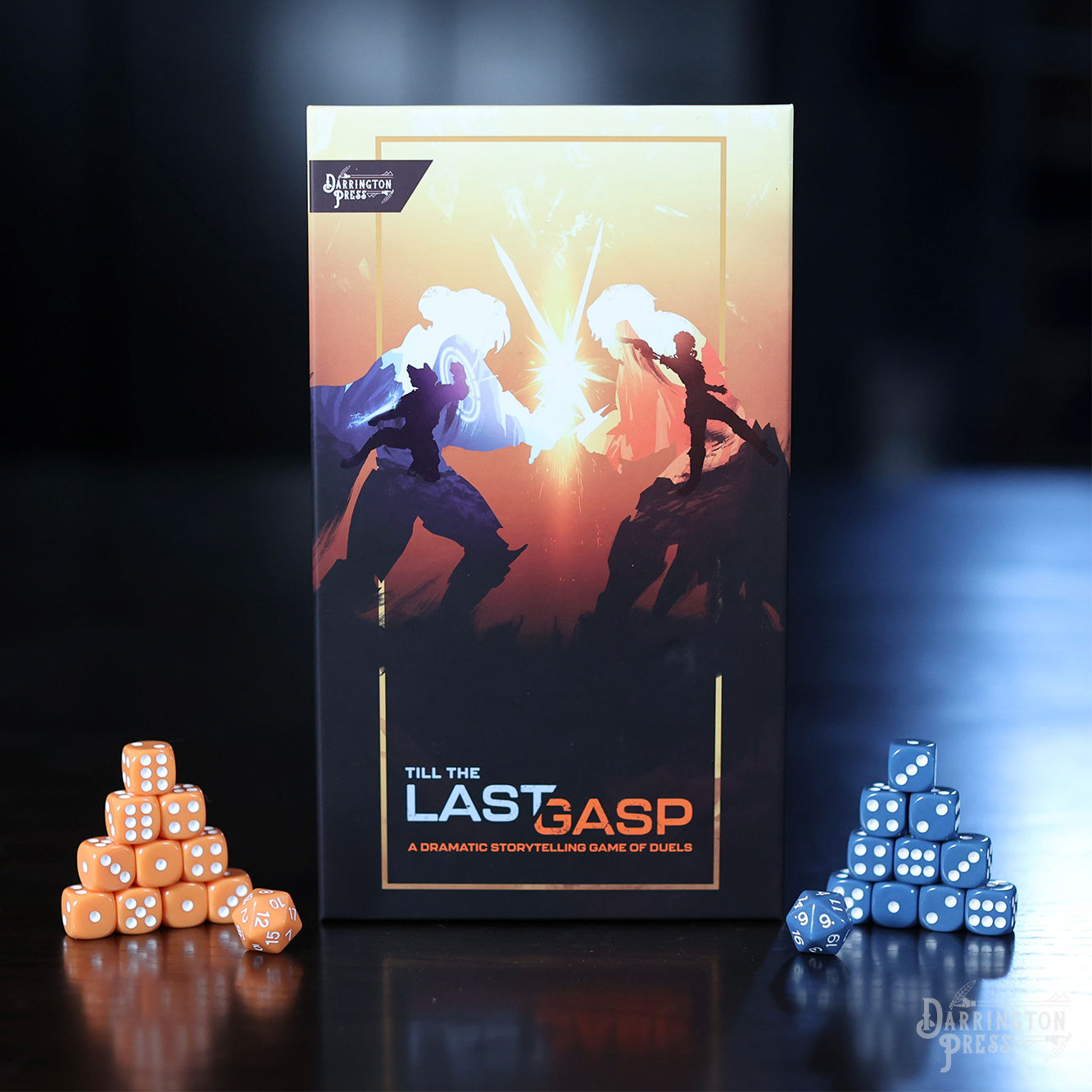


Till The Last Gasp is a tabletop game by Darrington Press that is all about dramatic one-on-one confrontations. With a dozen pre-generated characters and nine battlefield maps that cross many genres and settings there’s loads of replay value with the base game. However you can also create your own characters (but not locations), by answering a set of purely descriptive questions about each character. There are no attributes, levels, skills, feats, talents to worry about. Characters can fight with weapons, rhetoric, superpowers, magic, ultratech, psychic powers, or trained monsters, it all possible. 

As for the mechanics themselves there is a bit of a learning curve. The mechanical layer exists to set the pace and tempo of the conflict. There’s definitely a ‘tactical’ level to this game, as you juggle your stance card versus the allocation of dice to defense and offense. Using the battlefield is key to every Objective card and each of the locations on the maps offer their own opportunities for narrative and tactical play. There’s no rolling-to-hit or rolling for damage here. Each combatant chooses a set of Objectives that are their victory conditions. First player to achieve three objectives then gets the chance to ‘end the duel decisively.’ 

While you could play TtLG purely for the tactical ‘win,’ like you would MtG, you’d be skipping out on the biggest part of playing: The dramatic improv acting and storytelling. Your character’s traits are all narrative and motivational. Your Objectives prompt you to describe or enact your character’s actions, thoughts and feelings, and just as often prompt your opponent to do the same. Locations on the battlefield will do this too, as will Drama cards that are drawn often and throughout the duel to add more narrative flavor. Your character will be affected by these moments and revelations. The game encourages this, which is why the stakes of the conflict will change as the game progresses. A friendly bout to prove who’s the better may turn deadly as egos are triggered and tempers flare; a duel to the death may instead result in a change in someone’s allegiances. Rivals become deadly enemies … or lovers. It's all in how the cards, dice, and player choices turn out during the course of the game.  (As a side note, this reminds me a lot of the concepts behind Thirsty Sword Lesbians and the kind of drama that game seeks to enact.) All this hinges on the player’s abilities to emote their characters. If you leave the table without a sense of having experienced a dramatic encounter that changes the character’s lives forever, you’re doing it wrong.

Till The Last Gasp has all the benefits of what I'll call ‘modern gaming culture.’ There is a heavy emphasis on cooperation, collaboration, respecting boundaries (This is the first game I’ve encountered that ships with an X card). At any time either player can de-escalate the stakes of the conflict, but it takes both players agreeing to raise the stakes. The official last step of the game is to shake hands and leave the table as friends.

The production values for this boxed game are impressive; From the folding player boards, to the ‘battlefield’ maps, dice, cards and tokens, everything is well made and made to last. One can tell that the makers of the game are gamers themselves because of the attention to details present. There are ziplock bags for all the components! The only thing that would make it perfect were if the box it all came in were designed for reuse, like with a hinged lid rather than the classic clamshell pieces design.
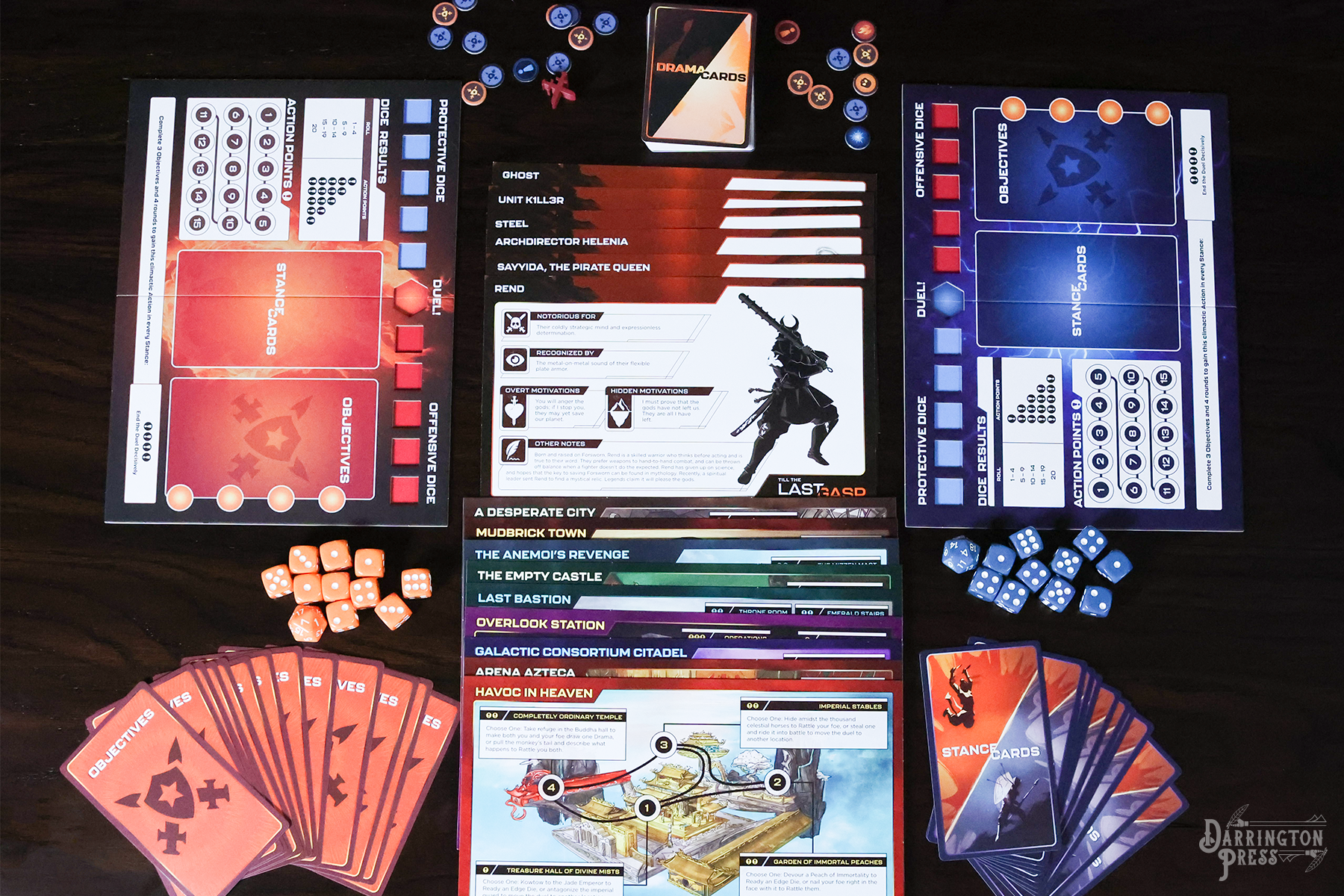


One hope I had for this game was the possibility to use it as a kind of ‘mini game’ in concert with other game systems/engines for when the normal rules couldn’t handle such a dramatic confrontation as well as one might like. After reviewing the rules as written and discussion with fellow gamers, I’d say TtLG mostly accomplishes this goal. While it might be tempting to tweak the rules as written to give a combat-focused character some form of edge over a non-combat character, from a purely narrative point of view that’s unnecessary here. Character motivation is more important than ‘skill’ in TtLG, and that should be embraced when playing it. The plucky and determined courtier has just as good a chance as the bitter duelist hired to silence them. The only thing I’d like to see is how to make new battlefields for your duels, but the basics of how they work are straightforward and easy to use or re-use for your custom settings.  

If you’re a skilled improv actor, you’ll get this game play right away. If you want to get better at improv, this is a good game for you. If you want your battles to be meaningful, emotionally impactful to those involved, and memorable for the ebb and flow of drama, this game is for you. If you just want to kick down doors, slay orcs and count gold pieces, this isn’t for you.


Monday, October 17, 2022

Review: Homeworld Revelations


 Overview

Taking a computer game of fleet management and tactical combat and making a pen-and-paper tabletop game from it was an ambitious task, and the Modiphius team have done a great job of it. Instead of producing a super-complicated, crunchy and hyper-simulationist game, Modiphius gave Homeworld: Revelations a very character and story driven focus that cares more about good drama than strategic fidelity.

A little background

Homeworld, the computer game, came out in 2000 (yes, children, there were video games before the millennium and some of them were damn good) earning numerous awards including E3’s "Best Strategy of the Year", PC Gamer's "Game of the Year" award, IGN's "Game of the Year" award for 1999, and USA Today called it "Top Game of the Year". The original game was followed by Homeworld:Cataclysm the same year, and Homeworld 2 in 2003. Homeworld Remastered was released in 2015, and a prequel game, Homeworld: Deserts of Kharak, was released in 2016. Homeworld 3 is set to release next year (2024) and this month Homeworld Mobile released for iOS and Android devices.

The Homeworld games are all Real Time Strategy games where the player directed the efforts of a fleet of space (or desert) vehicles in a series of missions in a campaign that combined to tell a grand story. Thoroughly voice-acted and delivering stunning visuals, the Homeworld series combined epic storytelling with tense decision making, limited resources and tactical combat.

For me personally Homeworld has always been one of my favorite games series. The stunning visuals, music and animatic-styled cutscenes were a beautiful relief from overdone cutscenes and awkward FMV acting of the day. The galaxy-sweeping story of a long lost peoples first returning to their ancestral homeworld, then defending it from existential threats, was epic and compelling. The ‘side story’ of Homeworld: Cataclysm was especially moving in the quality of storytelling and voice acting which really sold the drama.

But Homeworld has always been a tactical/strategic story. The playthroughs are the same, and only advance when you succeed in the chain of challenging missions that make up their arcs. Many missions had only one ‘right’ solution and in many ways the story missions served as training for the player in how to best manage and maneuver their fleet. 

But we’re not limited to PC simulation games anymore. Thanks to the Homeworld: Revelation tabletop roleplaying game.

The Core Rules

Homeworld: Revelations (herein to be referred to as “HW:R”) is a 2d20 game, produced by Modiphius. In the last few years, Modiphius has emerged into the industry as a game producer of note. The flexibility of their house 2d20 engine has supported RPGs for such diverse IP’s as Conan the Hyborean, Dishonored, Fallout, Star Trek Adventures, Infinity, and DUNE among others. This year (2022) Modiphius also released a 2d20 System Reference Document, opening the 2d20 system to writers to come up with their own games using this versatile system. They’ve also become publishers of a variety of non-2d20 games such as the Elite Dangerous RPG and Liminal, and wargames like Fallout: Wasteland Warfare, The Elder Scrolls: Call to Arms and Five Parsecs From Home, and many others.

I’ve written previously about 2d20, specifically my review of Star Trek Adventures, and HW:R is a pleasantly familiar riff off the ST:A ruleset. It has a wonderful emphasis on character  cooperation and it’s ‘momentum and threat’ mechanics give your sessions a kind of meta narrative power that allows players and GM to influence the action beyond just rolling to hit and rolling damage. HW:R has a more developed character advancement system than ST:A does. 

Character creation

HW:R characters are similar to ST:A characters with six ability scores and six broad ‘skills’, plus Talents and Focuses and ‘Truths’. Character creation is done in phases: choosing or rolling randomly for Background, Environment, Upbringing, Profession and Career events. By the end, you’ll have a character that is broadly competent with added focus on their specialties. The book assumes you’ll be playing a Kushan/Higaaran, but all the ‘races’ in the Homeworld verse are essentially human, so playing a Taiidan, Kadeshi, Turan, or even Bentusi should be easily adaptable. Options exist for in-play main character and supporting character creation. (The supporting character growth from ST:A would supplement the core HW:A rules nicely.) 

One minor complaint I have is the personal equipment of the setting is remarkably pedestrian. For a sci-fi setting, the choices for personal equipment and weapons are limited and not terribly imaginative. HW:R is a more hard sci-fi setting than Star Trek, but even so I expected more energy weapons and advanced tools to use. On the plus side, there are plenty of examples of more interesting equipment and tools from related games, like Infinity, which can be ported over. 

Ship combat and construction

Homeworld: Revelation treats ships like characters, which is great for story-based storytelling. It means a cinematic focus on character and ships are characters rather than focus on a map and pieces on a board. The 2d20 system handles this well. One twist from how ST:A and HW:R treat ships is that while in ST:A ships have ‘departments’ which function like Skills, Homeworld ships don’t. In ST:A, when you perform an action using a ship’s systems and technologies, the ship helps you in your test with its own dice roll using its Systems + Department scores. In contrast: in HW:R you use the ships’ Stat with your own Skill rating. HW:R ships also don’t have shields, like most ST:A ships do: Combat is dangerous and getting disabled or destroyed is easier in HW:R compared to ST:A.

There’s a wealth of ship designs from the original Homeworld computer game, both the player-controllable versions as well as the mission-only specific designs that formed crucial challenges during the campaign.

Ship creation follows two methods: first is “take an existing ship and modify it,” and second is a more detailed methodology starting with a base scale and making choices with a limited pool of points. On the one hand this is far easier than, say, 2300AD’s Aerospace Engineer’s Handbook, and the HW:R book has plenty of examples of the exotic and weird technologies of the Homeworld setting. On the other hand, this system heavily penalizes smaller ships over bigger ones by limiting the points available for customization. In my opinion the GM should just tweak things to fit their story needs and not worry about ‘point balancing’ things. 

Historical and cultural infodump

The HW:R book details the extensive historical background of the Homeworld universe, and gives plenty of hooks for creating your own stories within its many-millennia old universe. One of the concerns I had when anticipating this game was ‘what are my players going to do?’ and this book does a good job of providing ideas for games set in several different timelines: from before the events of the original Homeworld Game, to events hinted at in the forthcoming Homeworld 3 game. There’s also sections describing the major ‘geography’ of the galaxy and notable locations visited in the games. These should be sufficient for inspiration for new additions in your own games. 

The HW:R book contains plenty of material on the main cultures of the Homeworld games: the Kushan, the Hiigarans, the Turani, Taiidani and Bentusi, and it is made clear that there are plenty more cultures that aren’t detailed in the setting. It’s a big galaxy, after all.

There's a long section describing Kiithid society (the hero culture from the computer games), intended to give major insight and inspiration to roleplaying characters in the game. The other major cultures (Taiidan, Turanic, Kadesh, Bentusi and even the progenitors) get a thorough writeup as well.  

Gamemastering and cast of characters

Finally, the “Gamemastering” and “Non-Player Characters” chapters of the core book give advice on using the specific tools for the GM that the 2d20 game engine provides. The NPC chapter gives many examples of allied, neutral and enemy characters for your games. 

Pros and Cons

+ The flexible 2d20 game system. If you’ve played any other 2d20 system, HW:R will be easy to get into, even with ship combat added to the mix. Coming from Star Trek Adventures will be even easier.

+ Loads of lore, setting and background info that expand well upon the Homeworld universe. 

- Initial equipment options are bland and lean, compared to many other Sci-Fi RPGs. Plenty of room to add your own ideas and those from other games, however.

+ Every ship and objective from the original Homeworld game is here with stats and background.

- Ships from Homeworld: Cataclysm, Homeworld 2 and Deserts of Kharak are absent, but can be abstracted or built using the included design framework.

+ Setting details that allow playing in multiple era’s in the Homeworld series. An ambitious GM and group could even run a ‘legacy’ series of stories where they play descendants of characters from previous games.

- I want more but this is just the first book, and maybe Modiphius will open up the RPG IP to fan-made content if they don’t publish more material themselves.

+ One could run a pseudo-wargame with this game. It wouldn’t be Star Fleet Battles, but if that’s what you want go play that. 

Verdict

Homeworld: Revelations has been worth the wait. This is a slick game of character drama set in a universe of epic quests and action, back-dropped by mass spacecraft battles without overly complicated rules. There are plenty of story hooks baked into the historical and background information sections. 

I give Homeworld:Revelations 5 out of 5 stars.


Friday, April 19, 2019

Mobile games and the illusion of choice

So on a whim, i downloaded the super-hyped "Star Trek Fleet Commander" mobile game. Free to play but pay real monies to advance in a reasonable lifetime. Like most mobile games that are more complicated that Fruit Ninja this game gives you an utterly awful illusion of choice.

Sure, there's a 'deep and varied' tech tree for researching

Sure, there's a 'wide variety' of buildings to construct, manage and upgrade.

Sure, there's dozens of starships from canon and unique to this game to build.

Sure, you can recruit tons of characters from the 'verse to crew your ships.

However all these sub-systems don't actually present you any choice; you must upgrade in a specific order, often waiting until thing X over there has been updated a few times before you can even start on Thing Y, which you need to even dream about doing Z. The game helpfully has built-in links so that if you're missing a pre-requisite a handy tap will take you to the node/module/building that hasn't been paid enough attention to yet (which more often than not has two or three more things that have to happen first). But I submit that if you have to build in helpful links to navigate an intentionally byzantine progress tree, you're fixing the wrong problem.

Really, the upgrade game could be reduced to 'tap this one button to upgrade the next necessary thing', and skip all the fliting around looking for the one obscure prerequisite you've neglected and now suddenly need to pay attention to. The game knows what you need to do and the order you need to do it, and the AI 'character' who's ostensibly there to help you knows what to do next. Making the player stumble thru the miss-presented 'options' until they do the right thing is insulting to the player's intelligence.

Your characters can only advance once you've unlocked enough character-specific 'shards'.
The more rare and 'valuable' the character, the more shards you need to promote them every level.
And shards are only available via random loot-boxes; character rarity plays into how often you get a given character's 'shards.'

The first couple hours of interaction is a railroad of forced actions, which I suppose is to teach you the basics of resource management and performing building and upgrades. In practice it's as bad and boring an experience as the opening to Skyrim in terms of not really letting you do anything but look around and experience a forced narrative.

As for the ships in the game: you're presented with a long list of pretty ships, but here as well there's no choice involved. You will start with the lowlylesst bucket, acquire all the intermediate and incrementally better crafts, on your way to the end-game stuff which people are really here to play. The JJ Verse Enterprise, for example, is one of the three LAST ships to unlock in the game at this time.
Talk about putting the carrot on the end of a mile-long pole...

Flying your ships around is a pretty easy to use interface. You can have a number of ships out doing things at the same time. The problem is: objectives are intentionally spaced out so you spend minutes waiting for your ships to get where they need to go, only to tap thru a couple dialogs, maybe make a choice, then find and tap on the next destination. Otherwise ship missions are: go kill "X guys of level Y or higher," which is as old and tired as it was in the days of Everquest.

Two days into playing it, and I finally broke down and gave it $4.99 real money to give me the premium currency (gold-pressed latinum, of course) which you use to skip the in-game resource and real-time costs of playing the game. I figure they deserve some money for the effort they put into it, but I don't know how much longer I'm going to actually play the damn thing.

In summary:
  • While thematically and graphically gorgeous, this game embodies all the terrible Skinner-box techniques and time-wasting design choices that game design has adopted into their paradigms like parasitical organisms; making themselves mandatory to engage with in order to play.
  • There's no choice here; no freedom of expression. At time of writing, I've unlocked PVP (wheee. not.) and I expect every other player, aside from the luck of the lootbox, has pretty much exactly the same ships, loadouts and even characters.
  • Really, the only things one could consider fun about this game is enjoying A) the luck of your lootbox rolls, and B) pride in sticking out the forced timers and actually building up to any level of accomplishment in the game.
Postscript:
Though I am a bit tickled about having unlocked this cutie:

Tuesday, September 25, 2018

Review: Star Trek Adventures by Modiphius games

A long, long time ago I picked up a boxed set game purely for the fandom of it.
The original Star Trek RPG, by FASA,circa 1986.

It wasn’t playable, IMHO, but it was nifty to own anyway and it had a small but devoted following. The tactical ship combat board-games were more successful and still ongoing to this day.

Then came along Modiphius. Along with the publication rights to the Elite:Dangerous, Tales of the Loop, Fallout, Mutant Chronicles, Robert E Howard’s CONAN, and Achtung Cthulhu, they recently put out a new Star Trek licensed roleplaying game.

And boy, howdy, is it better than that 1986 boxed set.

Titled Star Trek Adventures, it’s an ambitious -and in my opinion- successful attempt to mainstream the popular science-fiction franchise as a tabletop experience. Part of that success is due to the fact that out of the core rule book they support all three TV generations of the Star Trek universe: Enterprise, classic Star Trek, and the combined series of ST: The Next Generation, ST:Deep Space 9 and ST:Voyager. And it wouldn’t take much to expand that to the spin off series of Discovery, The Mirror Universe, and the plot-lines of the Star Trek MMO as supplemental material.

The core of Star Trek Adventures is Modiphius’ home-grown ‘2d20’ engine. At first I was a bit unsure about this system. Having been burned out on the deluge of ‘d20’ engine clones from the D&D 3.5 SRD flood, I was apprehensive about how Modiphius was going to treat my beloved childhood settings. And yet, the 2d20 engine has impressed me very much. This is no D&D clone, but a slick and relatively smooth new game experience. The fun I’ve had with Star Trek Adventures so far has made me eye Modiphius’s other 2d20 game settings (Corvus Belli: INFINITY and the reborn Mutant Chronicles) as possibilities worth investing in.

It also doesn’t hurt that Star Trek Adventure player characters are good at their jobs. StarFleet trains them very well, and you start the game with a very capable character in the fields they specialize in. 2d20 has a ‘momentum’ mechanic where extra successes generated by one player are banked for other players to capitulate on immediately. This gives your Federation characters a powerful sense of coordination and teamwork.

Character advancement feels slow however. But that fits within the TV-series feel of the game. Similar to FATE’s ‘Milestones’ for advancement, characters in Star Trek Adventures can shift around their abilities after minor milestones, and only improve them after reaching major milestones (‘Spotlights’ as the book calls them). Again, this is befitting the feel of the TV series, where one could argue that major characters were affected by lesser events, and only transformed by major ones that only occurred once or twice a season. But outside of statistical improvements, Star Trek Adventure characters grow by their reputations and service records, which have different effects. In our campaign we haven’t delved into this much yet, but it gives the GM a way to reward characters in alternate ways.

Another advantage of the Star Trek Adventure engine is that it treats Starships as characters in their own right, and this is very fitting of the feel of the show. Ships have the same array of abilities and disciplines that characters do, so it’s easy to see the synergy between ship and crew. Only a few additional details required by the technical details one is used to in a Star Trek game are added (shields, some power management, etc.), but Star Fleet Battles this is not.

Another compelling aspect of the game is that it allows the spontaneous creation of supporting crew as characters when needed, and in fact encourages their re-appearance in later episodes. This allows for players to still participate in adventures when their primary character isn’t directly involved; roll up a redshirt security officer, or a blue-shirted science team member for that away-mission. Every subsequent time a supporting character returns to play, they get a little more detail and stat boosts. This is how you get your Chief O'Briens and Lt. Barclays to become major characters in their own right after a few seasons.

So far our group has played two long sessions and we’ve covered A LOT over those two gatherings. Equivalent to an ongoing story arc. This has probably as much to do with the skill of the GM (not me), as well as all the players understanding that we’re sticking to a TV-esque format. We frame our scenes, transitions and breaks as one would a TV show. It’s been a refreshing restart to my tabletop gaming experience which has been lacking lately.

Titled: “Star Trek: Legacy” our campaign follows the crew of the re-commissioned Stargazer (yes, Picards' old ship) after she was recovered, refitted, and put back into service. In the big chair is a Trill captain, recently joined with symbiote; a Betazoid as her helmswoman, and an Andorian science officer who was raised on Vulcan.

The books themselves are beautiful and well designed. If you’re a Trekkie, and/or looking for a quick and fun game engine to enjoy, I feel confident in recommending this game. Modiphius is continuing to support the line, with miniatures, maps, published adventures and custom dice.